Operational Cooperation Offer
The "Sетка" network is seeking international cooperation and offers to get acquainted with our operational experience (December 1946 – May 1948). The text below serves as a demonstration of our analytical, historical, and architectural capabilities.
For publishers, literary agents, and translators: We are actively looking for partners to bring this intellectual spy noir to English-speaking audiences. If you wish to discuss publication, translation, or adaptation rights, please use our secure channel (Contacts).
THE SECOND CALL
INTELLECTUAL SPY NOIR · DECEMBER 1946 — MAY 1948
Prologue
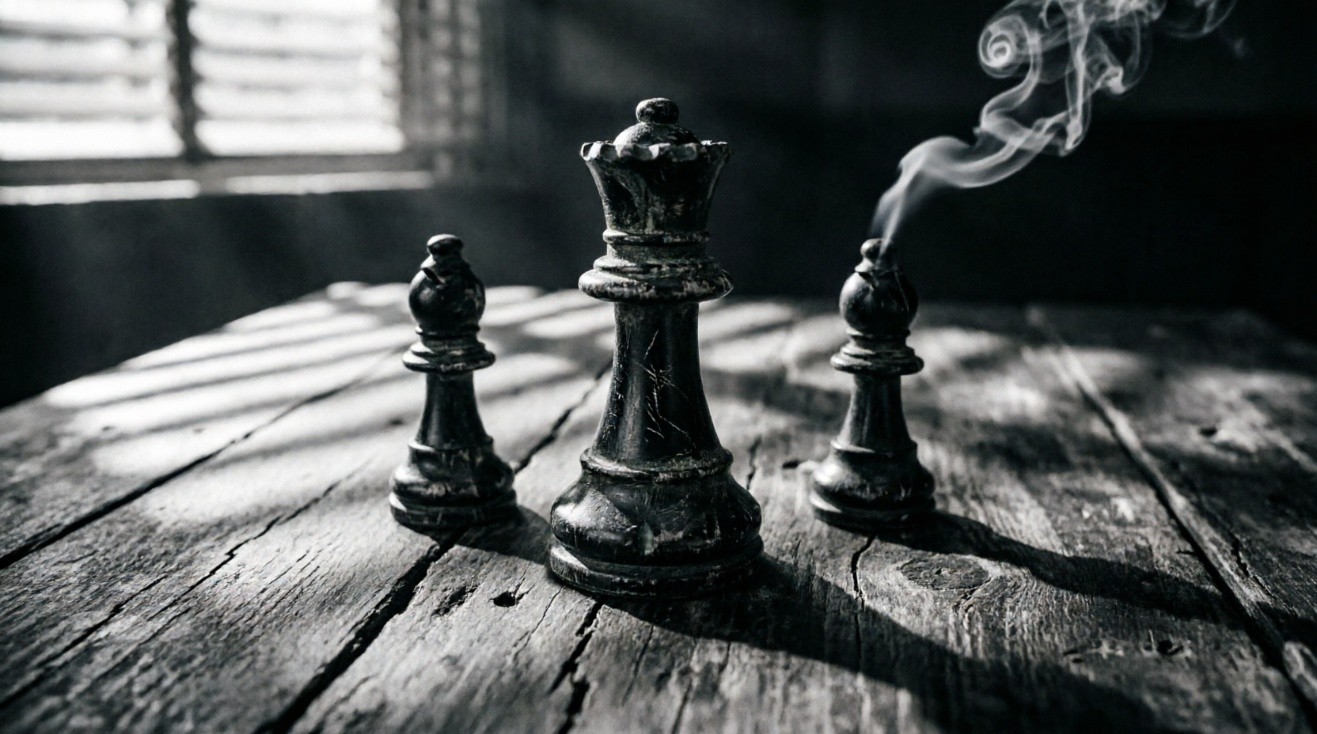
By December 1946, Europe had become a vast espionage proving ground where the old rules of the game had finally ceased to apply. The era of the “aristocrats of the spirit”, for whom espionage was a matter of honour, was being displaced by a new reality — the technocratic power of corporations and shadow organisations. The old school was fading, giving way to cold calculation, in which a man was merely a cog in the system and secret information a mere line in an asset ledger.
Post-war Switzerland found itself at the epicentre of this transformation: its cantons had become a colossal filter for the gold reserves and capital being channelled into Latin America. The conclusion of the Nuremberg trials and the signing of the Paris Peace Treaties had sealed the division of Europe, yet they had merely exposed the rift that would soon be called the Cold War.
TOP SECRET
CIRCULAR No. 447/C
12 December 1946
TO ALL UNITS
LINES OF WORK:
1. Control of illicit routes between Europe and Latin America (Argentine Republic, Dominican Republic, Haiti, Cuba). Particular attention to channels using smuggling as cover for the extraction of gold, currency and valuables. Priority: Switzerland, Italy, Spain.
2. Collection and neutralisation of materials capable of influencing the preparation of the Paris Peace Treaties. Identification of individuals using compromising material to exert pressure on the process.
3. Transition to new methods of intelligence transmission. Activation of previously dormant agents. Updating of operational channels.
CENTRE.
NIGHT
Bern, 12 December 1946, 23:07. (Junkerngasse 63)
He had begun waiting five cigars earlier. The ash never fell — he removed it at the very last moment, with two short movements of his fingers. Without haste. Without a glance. Just as he had once removed men from their posts, struck countries from maps, and struck questions from the agenda. He was always ahead. By one step. By two. By a lifetime.
The study was cold. Not out of forgetfulness, but conviction. In December he never turned on the heating. The cold disciplined thought. The cold did not allow memory to relax its guard. The wooden panelling, which still remembered the era of great upheavals, absorbed this cold, becoming almost stone-like. Every detail in this study had been thought out to the smallest degree.
The slender second hand of the Patek Philippe cut time into identical slices almost silently. He had not looked at his watch once that evening, yet he knew every minute. The music had ended. The gramophone continued to turn, but the needle merely scratched the groove.
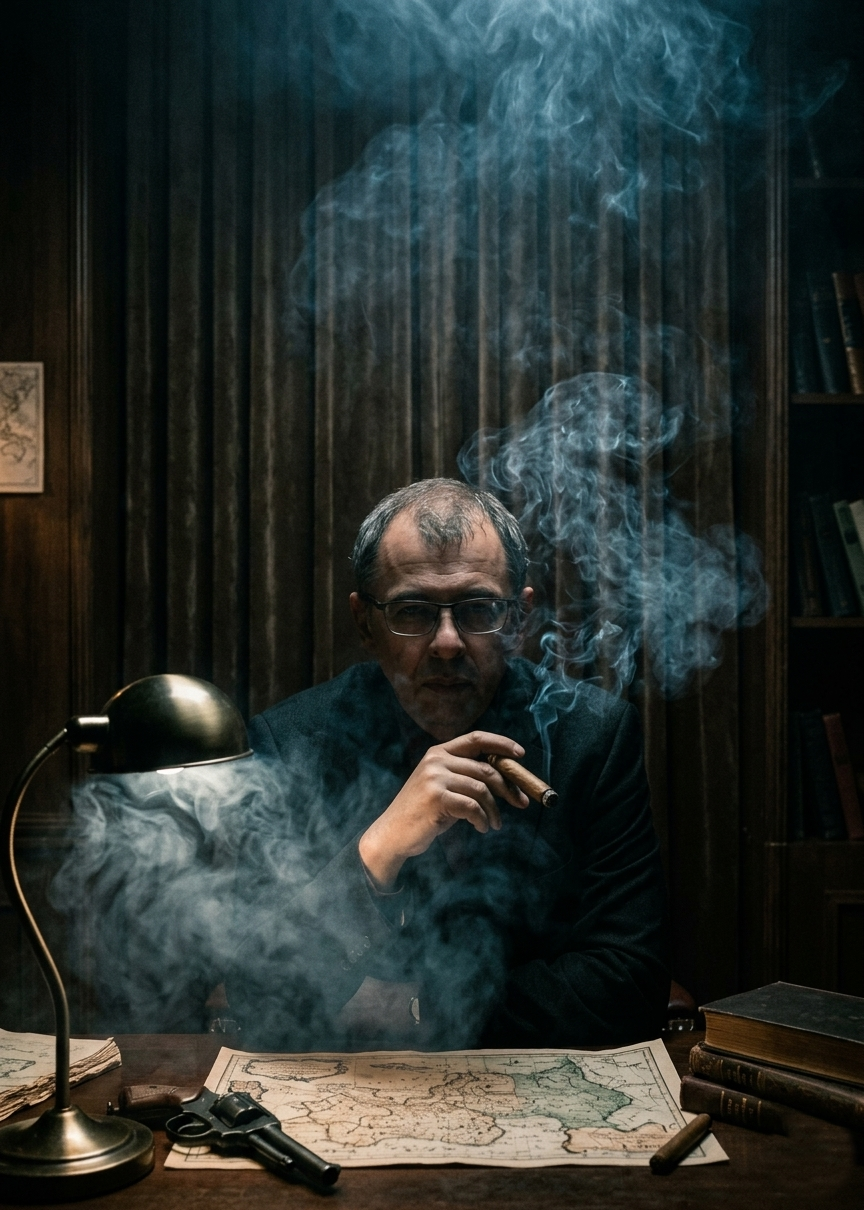
Then came Richter’s turn. Allegro non troppo e molto maestoso [Not too fast and very majestically].
The heavy opening chords slowly filled the study with their weight. Richter never played for the listener — he played for eternity. He needed a little more time to prepare for what was to come.
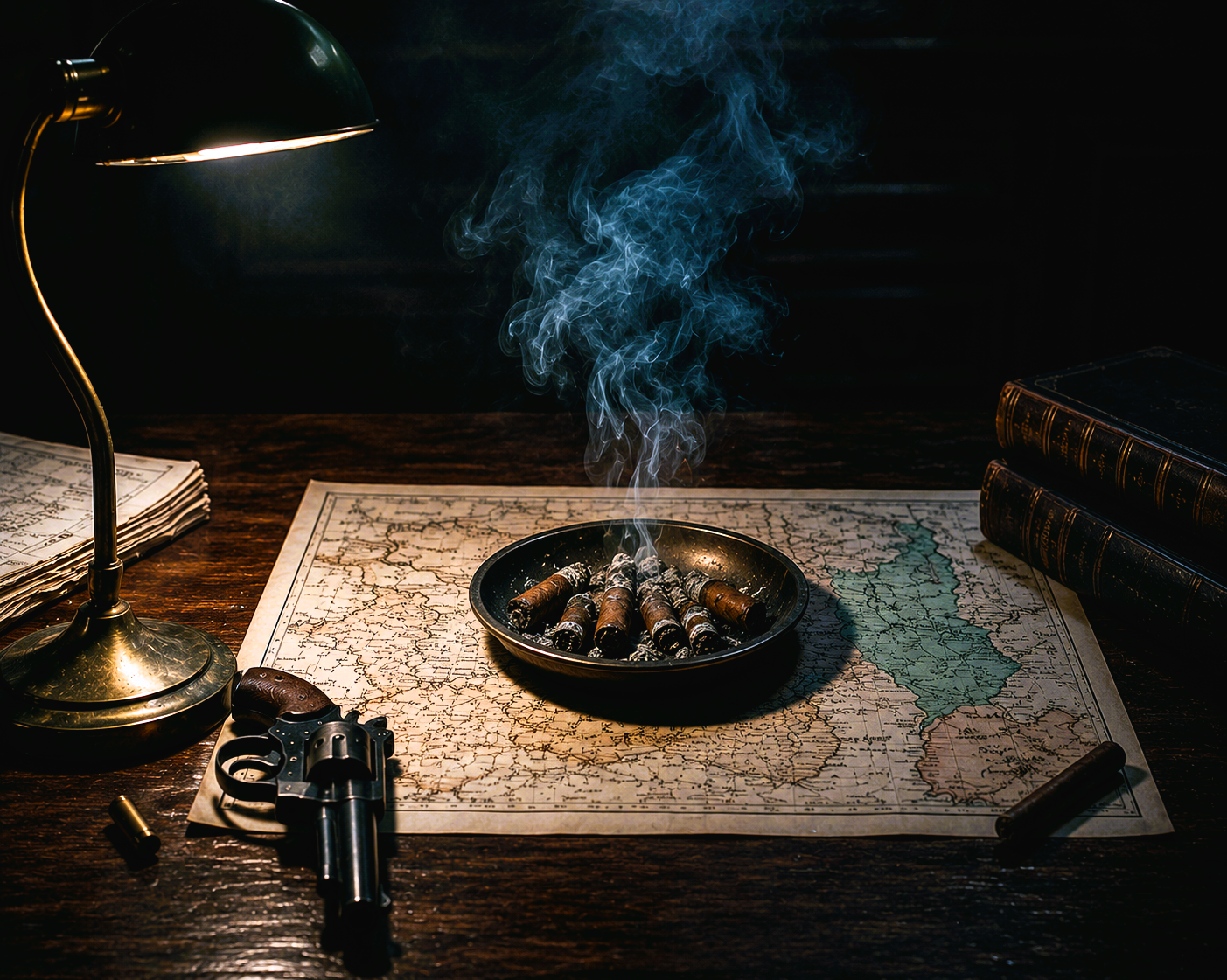
On the desk lay five short cigar stubs — identical, neat, almost symmetrical. He always extinguished his cigar before the fire reached his fingers. That was the right way. That was always the way. His entire life consisted of this: not waiting for the flame to burn him, but deciding himself when it was time to stop.
The telephone remained silent. He opened the revolver cylinder. Checked it once more, though there was nothing to check. Five empty chambers. One loaded. The metallic click sounded unexpectedly loud, cutting through the music. Now he was ready.
Only the second call remained.
Walter entered quietly. But the old floorboards still responded with a faint vibration beneath the carpet. They were two hundred and sixty-three years old, and in that time they had learned to distinguish people by the weight of their tread. Walter was soaked to the bone.
Steam rose from his wet overcoat and broad shoulders. The rain seemed still to cling to him, unwilling to let go.
He said nothing. He merely nodded. The man at the desk did not reply. He did not even move. The light of the green lamp lay upon his face as motionless as upon bronze. Walter stood for another second, as if expecting something, then turned and left. The floorboards trembled once more.
The door closed. The house grew calm.
And only then did he slowly open the revolver cylinder. Five empty. One inside. For several seconds he stared at the cartridge as if seeing it for the first time.
The second call had not sounded here. It had sounded where it was meant to.
Tomorrow the newspapers would appear as usual. The radio would speak in ordinary voices. Another nine and a half cigars, and the city would awaken.
He switched off the lamp. And darkness immediately took its place, closing this episode forever.
TOP SECRET
FROM OPERATIONAL REPORT No. 02/C
Executor: The Maestro
13 December 1946
Classification: “Personal to Centre”
CONTENTS:
Communication channels with the Caribbean directorate have been established. Reserve lines have been mothballed. The new method of data transmission via a cultural event will be tested within 24 hours.
Dominican line: contact with the target established. Information on radar systems gathered.
Argentine line: target identified. Further development required.
MORNING
Bern, 13 December 1946, 07:43. (Junkerngasse 63)
The floorboards answered not with a watchful creak, but with a deliberately sharp tap. The door yielded without effort. The Guest entered without knocking. Without invitation. For the first time in many years, since their very first meeting, he had come of his own accord.
The Maestro looked him steadily in the eye. Neither blinking, nor asking, nor waiting for an explanation. There was a quiet reproach in that gaze.
The Guest stepped over the threshold — and paused half a step in. The lamp on the left. The globe on the right. The spines on the third shelf — in the exact same order. He finally realised why his own study in London’s West End so closely resembled the Maestro’s study in Bern.
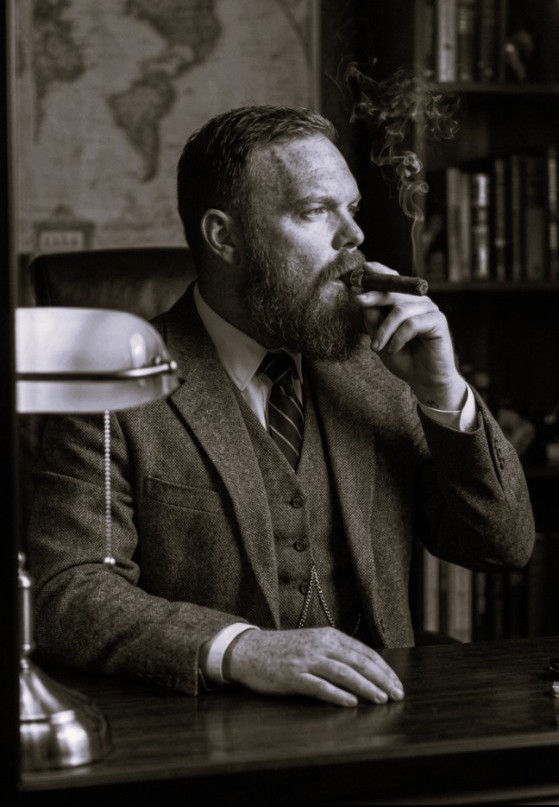
In his hand, a morning newspaper, published earlier than usual. Folded tightly in four. Not for reading. Like a pass. He did not unfold it. He merely tilted the sheet slightly, indicating with his gaze a tiny notice in the bottom corner.
The Maestro did not bother to search for the text with his eyes. The angle of the tilt and the absolute silence with which the Guest looked at it were quite enough. He nodded affirmatively, permitting the uninvited intrusion. The Maestro sat quietly. Without greeting. Without posture. He simply placed the unloaded revolver from the night before in the centre of the desk. The metal touched the wood evenly.
The Guest reached into his inner pocket. His fingers bypassed the lighter. The Mauser came out first — indecency heavy, suspended in the air, caught by the barrel. A non-firing grip. An instrument, not a threat. An answer to the revolver lying between them. That was how they were taught where the price of a mistake was measured not in days, but in seconds.
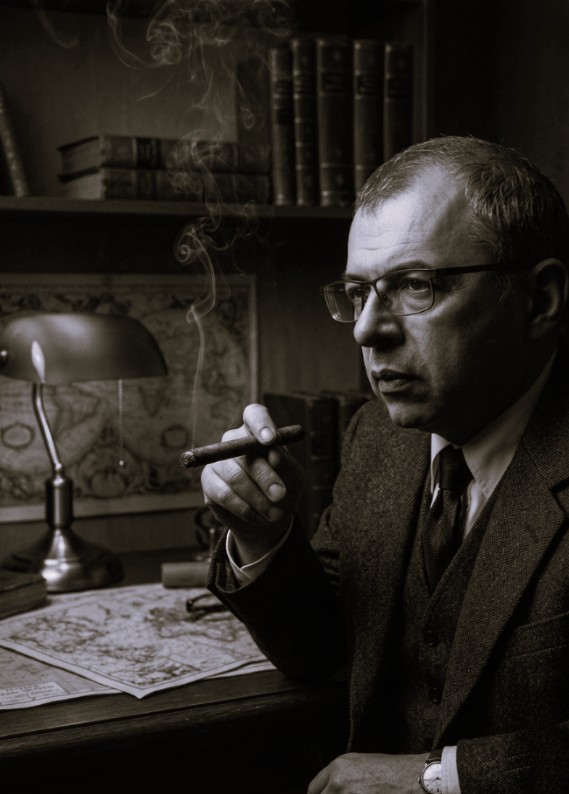
The Maestro did not look at the barrel. His gaze slid over the lenses to the cigar box in the Guest’s hand, then slowly shifted to his own, lying by his elbow.
The Guest followed this trajectory. The worn corner. The smell of damp leather and bitter resin. But it was not about the brand. The point was that this tobacco was not sold. It was grown in Lomas de Baire, cured in caves, and smoked only by those who had survived “the Kola”.
The cold Bern air was instantly filled with the memory of that hell. The Maestro saw the Guest’s Adam’s apple bob. They both remembered. “The Kola” — that stifling meat grinder north of Santiago, where there were neither laws nor mercy, only instinct and the heavy, sticky smoke that burned itself into the lungs forever. He who survived the Kola wore its scent upon him like a scar. The cigar in the Guest’s hand was no luxury. It was a shibboleth. A pass into the club of those who had seen the bottom and returned.
The Maestro nodded slowly. His gaze no longer scanned for a threat.
The lighter clicked for both of them almost simultaneously. The flame did not touch the tobacco; first, the foot was toasted. A slow rotation. Three hundred and sixty degrees in two seconds. The foot glowed with an even red ring. The cigars were raised to the mouth. The first draw — long, steady, on the inhale. Their heads tilted slightly forward. The exhale did not drift upwards, but horizontally, in opposite directions.
Two streams of smoke, cold and dense, met in the centre of the room. They did not mingle chaotically; they braided themselves into a single cord, drifting towards the ceiling, recreating in this sterile study that very viscous, impenetrable stifling heat.
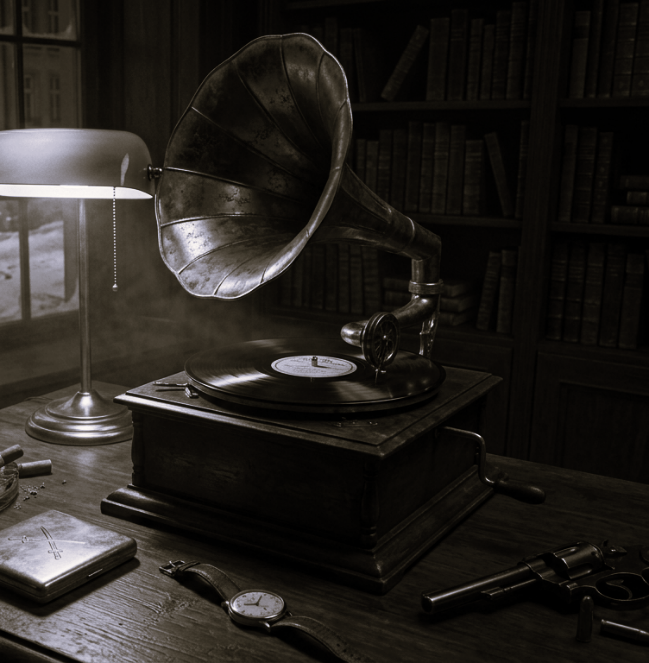
The light from the lamp did not touch their faces. It illuminated only the boundary of the merger.
Not a word. The Guest lowered his cigar, his lips barely moving. Clearly, without expression, only the articulation honed by years of silence:
“A-ce-pe.”
A pause. The smoke trembled.
The Maestro replied in the same way with his lips, without sound, only with the shape of his mouth, repeating the Guest’s rhythm:
“Mis-mo.”
The same.
The Guest nodded. Not with his head — with his shoulders. He turned. The floorboards trembled again, but this time in farewell.
The door closed. The house exhaled.
On the desk remained only the smoke, the cooling metal of the unloaded revolver, and the turning record.
Richter. The same piano concerto. The same recording. But how devilishly well he had played it this time. Not for eternity. For the two of them.
The needle touched the run-out groove. Silence took its place.
TOP SECRET
URGENT
13 December 1946
...
According to confirmed sources, customs and border control on the Swiss-Italian border is not in effect from 20:00 on Friday until 05:00 on Monday.
This regime will remain in force from 13 to 26 December 1946.
...
AGENT
LA TRAVIATA
Bern, 13 December 1946, 19:15. (Kornhausplatz 20)
Berne was greeting Christmas. The thirteenth of December had fallen on a Friday.
The superstitious crossed themselves as they locked their doors, but the theatre was full. The city smelled of pine needles, honey, and wet stone — snow had been promised, but a thaw had come instead, and the cobblestones gleamed like mirrors. On the corners, they sold roasted chestnuts wrapped in newspaper cones, and in the shop windows stood pyramids of tin cans of goose liver pâté and porcelain angels with gilding.
The Maestro stepped out of the car at a quarter to seven. A dark blue camel-hair overcoat, a grey felt hat with the brim lowered just enough to shadow his eyes against oncoming light, black kid gloves — thin as a second skin. He felt the cold seeping through the kid, but he did not wince.
He did not hide his face. His face was not in any filing cabinet. He existed only in agent reports under a pseudonym that changed every three months.
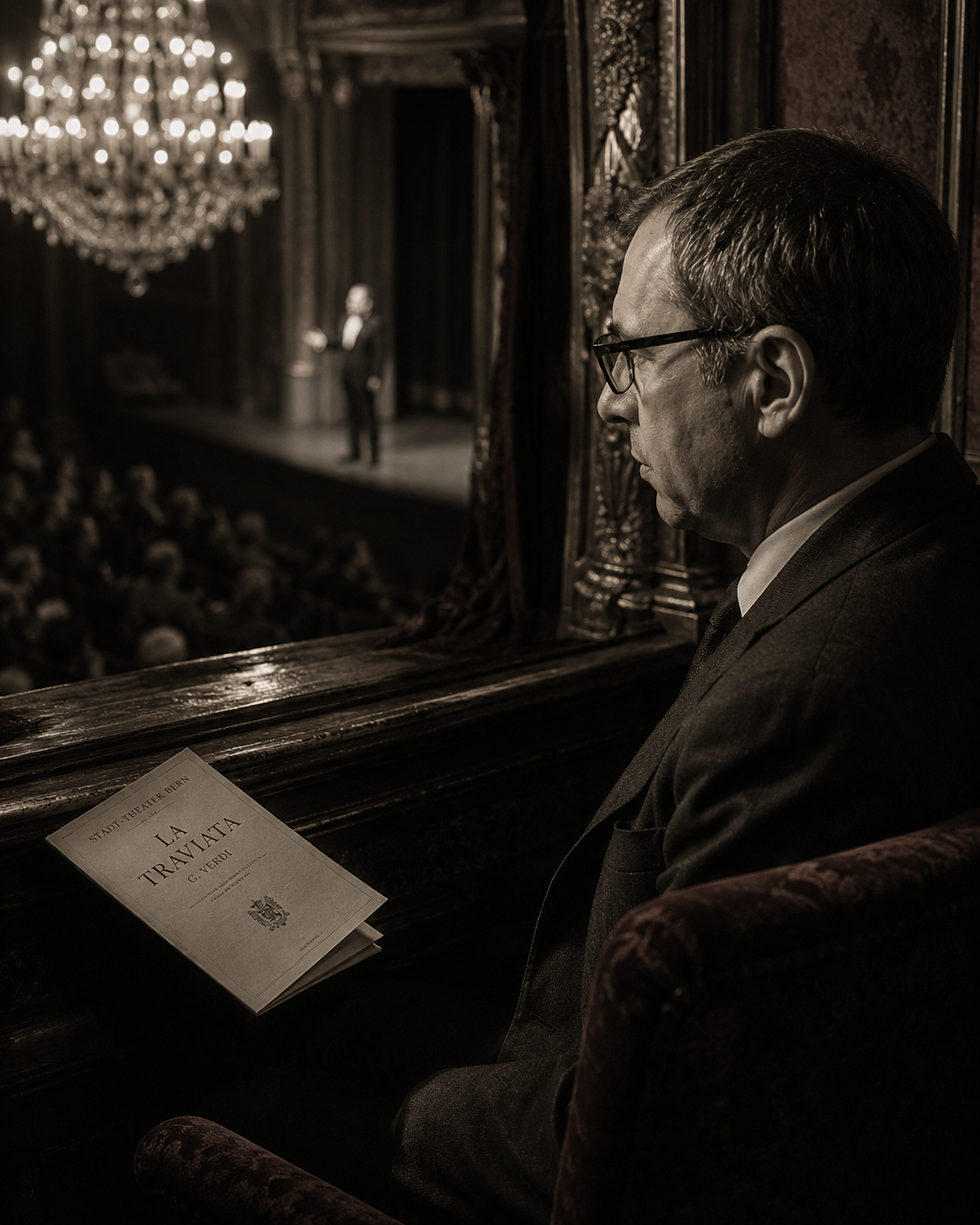
He caught the sidelong glance of an employee from the Argentine Embassy. The Maestro had seen him the previous summer at the Bellevue restaurant — the man had lingered too long with his eyes on his briefcase.
He had memorised the face then: narrow, with a long nose, the left eyebrow slightly higher than the right. On the lapel of his black suit, the badge of the diplomatic club glinted.
Argentina had turned into a breeding ground after the war. Nazi gold, forged passports, men with altered appearances.
A nest of bedbugs, the Maestro thought. Intelligence services from all over the world were swarming there. But destinies were being decided here.
After the opera, he would need to check if he was being followed. Paranoia was not an illness; it was a profession.
He entered the foyer.
The warmth struck his face, mixing the scents — polished parquet, expensive perfume, old wood from the panelling. The doorman in a blue-and-gold livery recognised him, bowing courteously. The Maestro handed over his coat, receiving a brass token on a slippery cord.
The programme lay in his left inner pocket. A thin booklet, smelling of printer’s ink and almonds. Tonight, it had a special role.
Box No. 3 — right of the stage. The door was heavy, upholstered in velvet, worn at the fold. He entered.
There were only two chairs here, upholstered in old crimson plush — prickly, rubbed down to the threads. On the right, a dark wooden rail, polished by the elbows of hundreds of spectators. On the left, an empty chair. He had ordered two tickets, but the second always remained unoccupied.
The Maestro sat down. The plush creaked. He placed the programme on the rail. Then, during the interval, he would fold it in half and leave it here.
The chandelier in the hall was dimmed; only the gas jet above the stage burned. The orchestra was tuning — the oboe took the ‘A’, the strings answered. The hum of voices subsided. The Maestro swept his gaze over the stalls.
The curtain rose. The orchestra played the overture. A tall German woman with a Russian surname was singing Violetta. She was portraying an Italian courtesan with a French accent. The Maestro mentally graded her: technique — eight, sincerity — three.
He did not listen any further. He was waiting.
The tenor, Di Stefano, was not due to appear until the second act. Currently, ballroom scenes were playing out on stage — chorus, dances, tinsel. The Maestro watched the conductor, the violinists, the double bass player — the man’s bow was trembling, he had a cold. Minor details, out of which security was built.
Eight minutes into the first act, he thought. If anything goes wrong, I will leave at the interval. The basket will be cancelled. The microfilm will go via the reserve route.
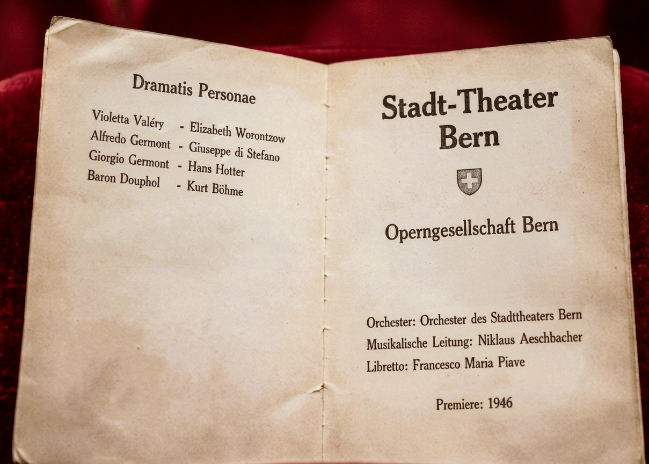
On stage, Violetta sang “Ah, fors’è lui” [Ah, perhaps he is the one]. The Maestro knew this aria by heart — every modulation, every fermata. He remembered hearing ‘La Traviata’ in Vienna in 1938, with Jussi Björling as Alfredo. The public favourite hadn’t known then that in a year his country would vanish from the map. The Maestro had known.
He knew everything about the intelligence game. And he could do practically everything.
He did not understand music. He had not studied music. It had come to him from that past about which he never spoke.
He knew music, and music knew him.
The curtain fell. The lights came up. The audience stirred, coughed. The Maestro took the programme — the paper was soft, slightly damp from his fingers. He placed it so that it was visible from the stage, but almost invisible from the hall.
I did the same in Lisbon, in ’43, the memory came. Only then, instead of a programme, it was a cinema ticket, torn on the left edge. The one who took it, tore the right.
Two hours later, a high-ranking Abwehr officer fell asleep in his bath forever.
The curtain rose again. Second act.
On stage, Violetta’s country house: trees painted on canvas, mahogany furniture. Alfredo entered.
Giuseppe Di Stefano was handsome. Thirty-two years old, dark eyes, a heavy jaw, black hair gleaming with brilliantine. He greeted the audience with a slight bow.
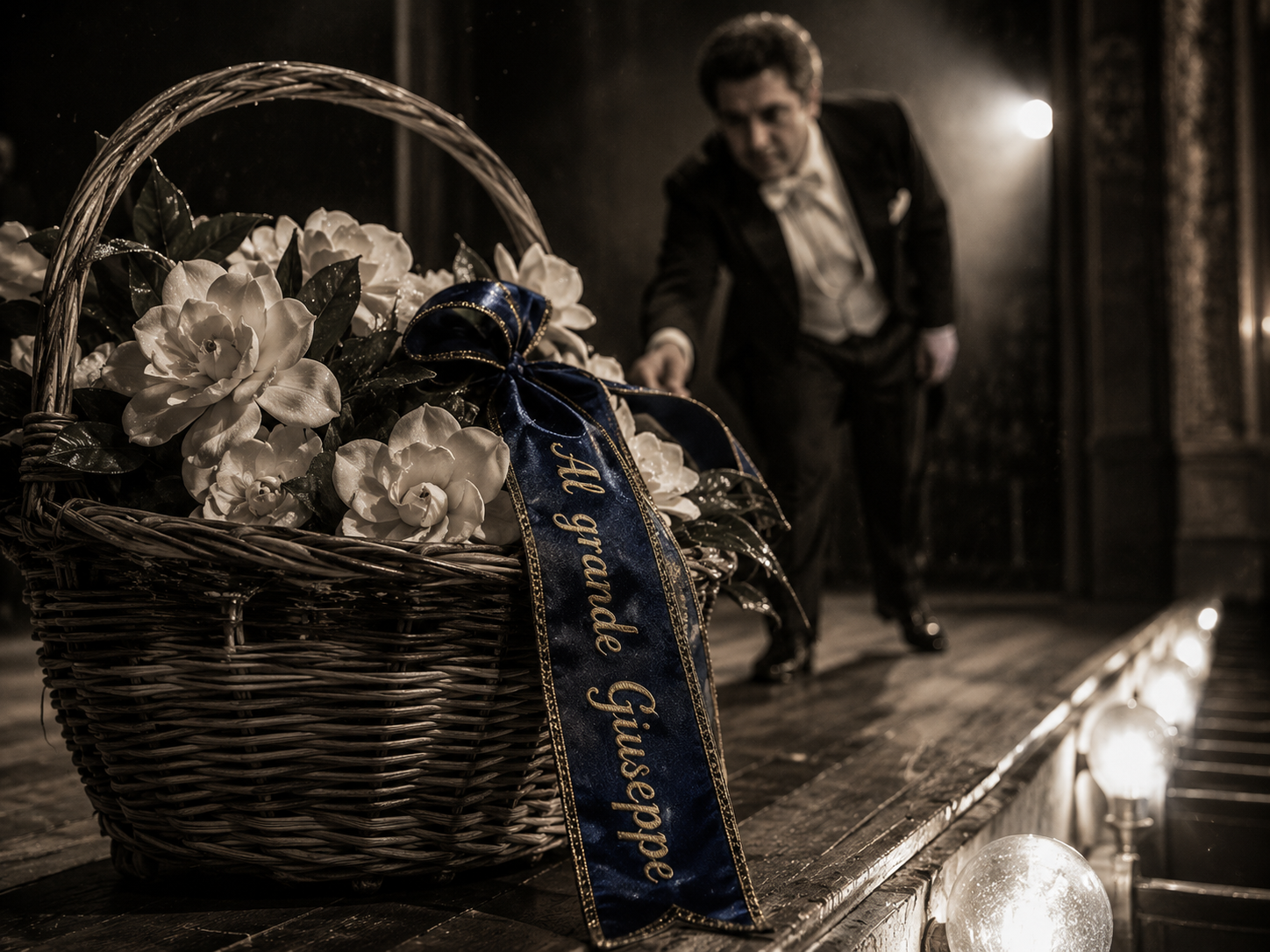
The Maestro did not look at him. He looked at the programme, maintaining the mask of an attentive spectator. Out of the corner of his eye, he saw: Di Stefano cast a glance at the box. The gaze lingered on the programme for a fraction of a second.
Understood.
Di Stefano did not know what this sign meant. He had been instructed: if you see a folded programme, everything is going to plan. Sing as agreed.
The orchestra played the aria ‘De’ miei bollenti spiriti’ [My passionate spirit]. Di Stefano began to sing. And then he approached the word ‘ardore’ [passion]. D’ordinary, les ténors abordent cette phrase en crescendo, avec éclat, triomphalement.
Di Stefano chanta autrement. Il attaqua la note piano, presque en chuchotant. Le son naquit comprimé, écrasé — comme un soupir. La voyelle « o » s’étira un peu plus longtemps, et le vibrato devint un peu plus rapide. Le public ne remarqua rien. Une dame au parterre murmura à sa voisine : « Quel Alfredo triste aujourd’hui. »
Mais le Maestro connaissait chaque souffle de Di Stefano. Jamais — pas une seule fois — celui-ci n’avait chanté ce passage doucement.
Compris. Confirmation. Il agira.
Le Maestro ne bougea pas. Son visage resta de pierre. Mais à l’intérieur — une joie courte et sèche, comme une gorgée d’eau froide.
Sur scène, Di Stefano se tenait de trois quarts. Et soudain — comme par désespoir, comme si le héros ne pouvait surmonter son chagrin — il passa cinq fois la paume dans ses cheveux, les rejetant en arrière. Le geste s’inscrivait dans le rôle. Mais le compte n’était pas fortuit.
Le Maestro sortit son étui à cigares en argent. Sur le couvercle — une gravure : deux sabres croisés. Cadeau d’un homme qui n’était plus. Son pouce trouva le fermoir. Il ouvrit et ferma l’étui пяти раз. Un. Pause. Deux. Pause. Trois. Pause. Quatre. Pause. Cinq.
De l’extérieur, on aurait cru qu’il réfléchissait simplement, faisant tourner l’étui entre ses doigts.
Cinquième ville. Compris.
Donc, à Lyon, Di Stefano transmettra le microfilm à un autre homme. La chaîne se bouclera.
Troisième acte. L’étui se referma. Violetta mourait. Le public pleurait. Le niveau tomba, se releva sous les ovations.
On apporta sur le plateau un panier de camélias blancs. Baguettes d’osier, vernis, dizaines de fleurs de velours, blanches comme la neige. Ruban bleu — le signe convenu. Soie, large, brodé d’or : « Au grand Giuseppe, d’un admirateur. »
Di Stefano s’approcha, se pencha, prit le panier. S’inclina profondément, détacha le ruban du panier, le plia soigneusement dans la poche de poitrine. S’inclina. À présent, le microfilm était à lui.
Tout. Dans une semaine, l’information serait à Paris. Photographies de radars. Tout cela pour quoi le deuxième secrétaire s’était noyé dans sa baignoire.
The Street.
Checking for a tail. He crossed to the other side, stopped by a shop window — cold glass, the reflection of his face with two gas jets. No one. He turned the corner, struck a match, looked at the flame. No one.
He returned to the theatre from the side of the stage door — dark, smelling of urine and coal. He stood for three minutes. No footsteps.
Clean.
He stepped out onto the main street. Night. Fog. Bells were playing somewhere far away. On the corner, a Christmas tree with garlands, the smell of roasted chestnuts and pine.
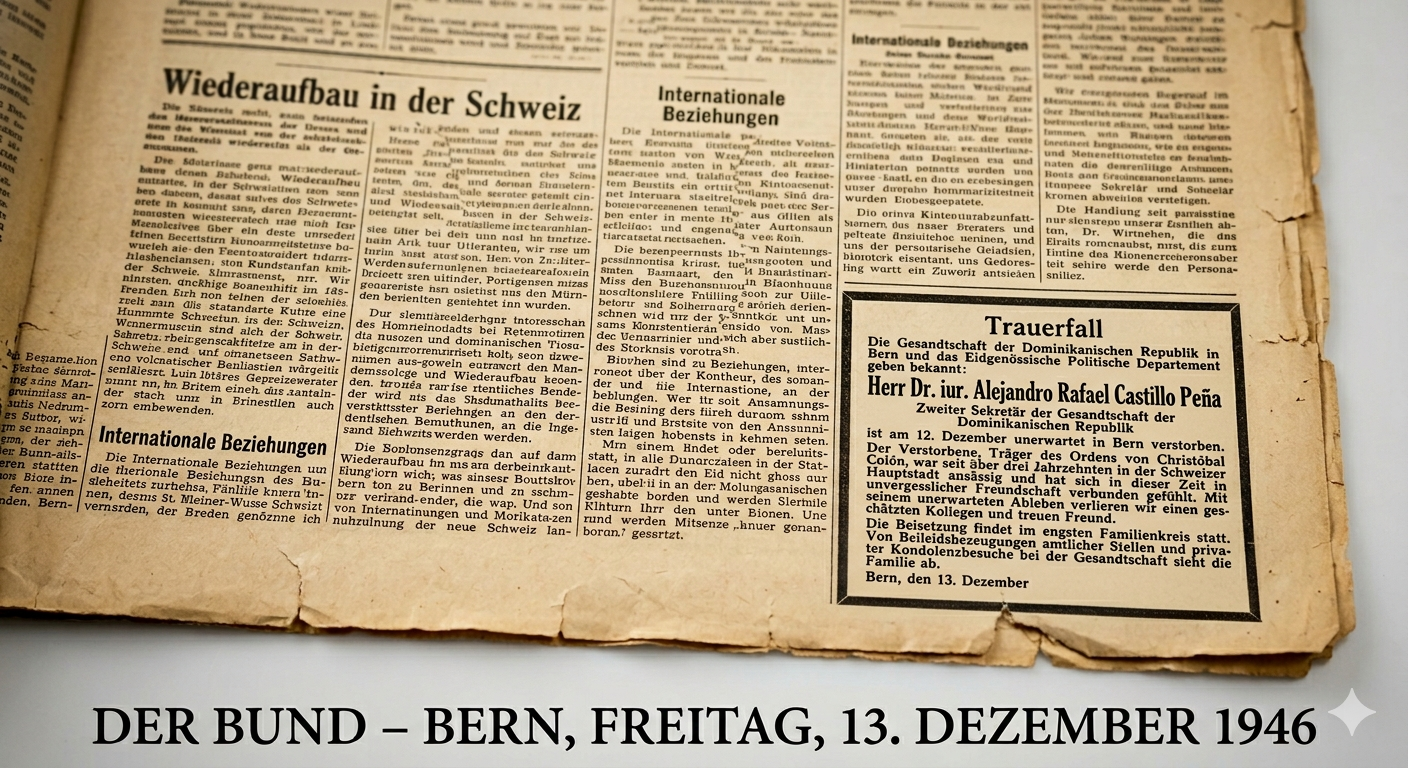
The Maestro stopped by a cast-iron bin. Inside — a crumpled newspaper. Der Bund. 13 December. He knew: on the back page, in small print, an obituary. The Second Secretary of the Dominican Embassy had passed away suddenly on 12 December. Drowned in his own bath.
But it did not write there that the day before this, he had pumped the name of the Maestro out of Sandros: the man had confessed to taking a folder from the embassy. Sandros was a weak man. When the doctor shouted at him, Sandros’s heart simply gave out — he could not withstand the interrogation.
The car pulled up silently. A black Horch. He loved it.
Walter was not nearby. Walter was already far away, with a different passport. Walter had done his job, his back no longer steamed from yesterday’s bathing of the Second Secretary.
And there had been no rain yesterday.
TOP SECRET
INTERCEPT No. 04/F
13 DECEMBER 1946
Encrypted message from "Argentinean" target to Buenos Aires. Decrypted 13 December 1946.
...
ORIGINAL TEXT (TRANSLATED FROM SPANISH):
An action to eliminate target "A" is being prepared in Bern. Executor — resident "Water" acts on behalf of the Grid. Time of action — 13 December, presumably within the city limits.